
Dogs · Mac and Windows
Meet the French Bulldog.
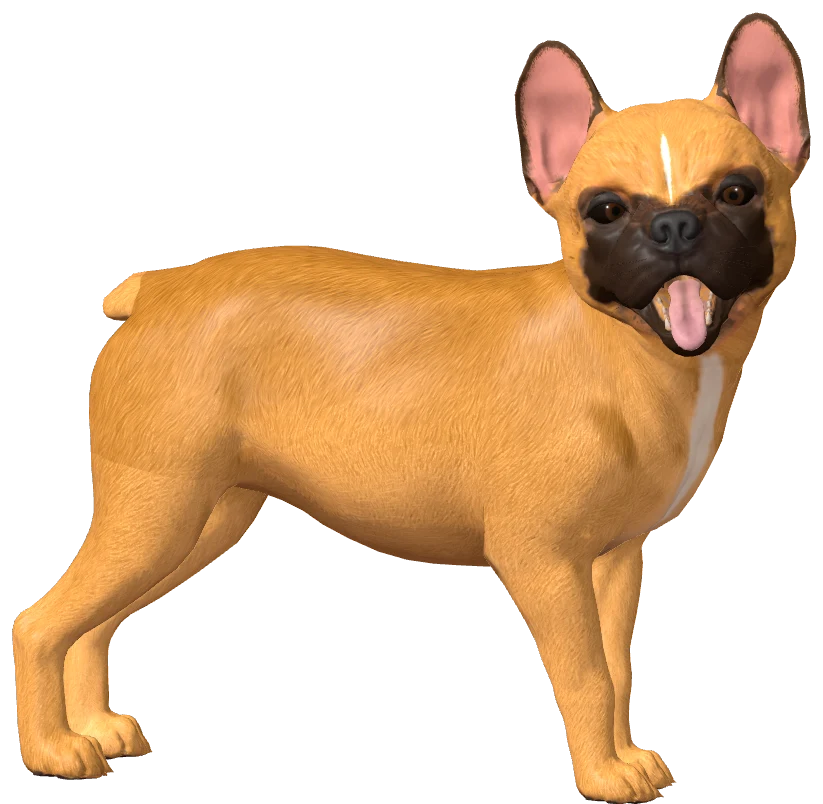
The French Bulldog is a small, sturdy companion dog with a square head, a short smooth coat and famous upright bat ears. Playful, alert and adaptable, the Frenchie was bred for company rather than work, and it now tops the American Kennel Club's popularity list.
Launch price $9.99, was $29.99
2 looks
Pick a look
French Bulldog
01
At a glance
A small, compact dog with good bone, a flat face, large bat ears and a short, fine coat in brindle, fawn or pied. Frenchies stand around 28 to 33 cm, weigh about 11 to 12.5 kg and usually live about 9 to 12 years. They are affectionate, clownish and people-focused, need up to an hour of gentle exercise a day, and as a flat-faced breed need careful health care. Sillmates makes the French Bulldog as a desktop pet companion for Mac and Windows, in Fawn and Pied coats.
02
History and origin
The French Bulldog's roots are in England. In the 1850s a dwarf Bulldog known as the Toy Bulldog was popular in parts of the country, especially with the lace makers around Nottingham. When the Industrial Revolution threatened their trade, many of them emigrated to Northern France and took their dogs with them. The little dogs spread from Normandy to Paris, crosses were probably made to other short-faced breeds, and after about three decades a new breed, the French Bulldog, had evolved. It became fashionable in Paris and appeared in paintings of Parisian life by Degas and Toulouse-Lautrec. American fanciers insisted on the upright bat ear and formed the French Bull Dog Club of America, the first club anywhere devoted to the breed. In Britain the French Bulldog Club of England was formed in 1902, and The Kennel Club recognised the breed in 1906.
03
Temperament and personality
The UK breed standard describes the French Bulldog as full of courage yet with clown-like qualities, and as vivacious, deeply affectionate and intelligent. Frenchies were bred as companions, so they are very people-focused and dislike being left alone even for short periods. VCA Hospitals describes them as friendly toward strangers, fairly friendly toward strange dogs and good with other pets. They are eager to please, which can make training easier, but they can also be strong-willed. As a sensitive breed they respond best to positive, reward-based training started early, and they may rebel against forceful methods.
04
Size and build
The French Bulldog is a sturdy, compact, solid small dog with good bone and a square head. The American Kennel Club gives a height of 11 to 13 inches and a weight of under 28 pounds, and VCA Hospitals a height of 10 to 13 inches. The PDSA gives an average height of 30 cm and an average weight of 11 to 12.5 kg, and the UK breed standard sets an ideal weight of 12.5 kg for dogs and 11 kg for bitches. The flat face makes the Frenchie a brachycephalic breed, and the standard says dogs showing respiratory distress or excessive breathing noise are unacceptable.
05
Coat and colours
The coat is fine, smooth, lustrous, short and close. Under the UK breed standard the only correct colours are brindle, fawn and pied, and The Royal Kennel Club lists breed standard colours including brindle, light and dark brindle, brindle and white, fawn, fawn and white, fawn pied, fawn with black mask, and pied. Colours such as black and tan and blue are non-breed-standard, and the Kennel Club reminds buyers that health and temperament should always come before colour.
06
Exercise and play
Frenchies need up to an hour of exercise a day, split into a few shorter walks with time to play off-lead in a secure area and have a good sniff around. VCA Hospitals suggests a leisurely walk or some backyard games, and obedience and trick training give essential mental stimulation. The flat face means they overheat and struggle to breathe very quickly, and VCA calls them extremely prone to overheating, so in summer walk early in the morning or later in the evening, and play indoors in warm weather. The short coat does not protect them from the cold either. They are not great swimmers, so keep a Frenchie on a lead near ponds and lakes.
07
Grooming and care
The short coat is easy to look after: a weekly brush is enough, and Frenchies are not known for shedding a lot. The skin folds need more attention. Facial wrinkles, and any wrinkles around the tail, should be checked, cleaned and dried daily, because warm, moist folds let bacteria and yeast grow and can lead to skin fold dermatitis. Frenchies put on weight easily, and extra weight makes exercise and breathing harder, so feed a complete, balanced diet and count the treats. Flat-faced dogs can also suffer from reflux or struggle to swallow their food.
08
Health and lifespan
Lifespan figures differ between sources: the American Kennel Club gives 10 to 12 years, VCA Hospitals 9 to 11 years, and the PDSA and The Royal Kennel Club say over 10 years. A Royal Veterinary College study, the largest of the breed in Britain, found French Bulldogs predisposed to breathing problems, skin fold dermatitis, cherry eye, eye ulcers, patellar luxation and demodectic mange. The PDSA also lists brachycephalic obstructive airway syndrome (BOAS), crowded teeth, cataracts, back problems such as intervertebral disc disease, and hyperuricosuria, and it suggests considering a different breed or a cross-breed. The Royal Kennel Club asks breeders to test breathing under its Respiratory Function Grading scheme, with DNA, eye, hip and elbow tests as best practice. If you choose a Frenchie, look for health-tested parents and a dog with a longer nose and wider nostrils, and see a vet about heavy panting or noisy breathing.
09
Living with one
Frenchies are laid back and adaptable, and tend to get along well with children of all ages. VCA Hospitals rates them very good with children, though rough play can hurt a Frenchie's back, so always supervise. They suit small homes, and The Royal Kennel Club rates them as fine in a flat or apartment. They do have a high prey drive: a Frenchie raised with a cat will be fine with that cat but may chase unfamiliar cats and smaller pets. Above all they need company. The PDSA advises never leaving a dog alone for more than four hours, and some Frenchies cannot cope with even shorter periods.
10
Fun facts
Early versions of the breed are said to have warmed the laps of English lace makers while they worked. Bat Ears is a nickname for the breed itself, and Toulouse-Lautrec painted a Frenchie called Bouboule, owned by a restaurant owner. A French Bulldog is even recorded as going down with the Titanic. And by 1940 the breed was so rare that only 100 were registered with the American Kennel Club.
11
Questions about the French Bulldog
Are French Bulldogs healthy?
They are prone to a number of problems linked to their flat faces, including breathing trouble, skin fold dermatitis, eye ulcers and slipping kneecaps. Choose health-tested parents, a longer nose and wider nostrils, and keep your Frenchie cool and lean.
How much exercise does a French Bulldog need?
Up to an hour a day, in a few shorter walks plus play and training. Avoid heat, as Frenchies overheat quickly.
Are French Bulldogs good with children?
Usually, yes. They are laid back and playful, but rough play can hurt a Frenchie's back, so always supervise.
Can French Bulldogs be left alone?
Not for long. They were bred as companions, and the PDSA advises never leaving a dog alone for more than four hours.
What colours do French Bulldogs come in?
The UK breed standard allows brindle, fawn and pied, with variations such as fawn with black mask. Blue and other colours are non-breed-standard.
Are French Bulldogs really French?
Only partly. Their ancestor was the English Toy Bulldog, taken to France by Nottingham lace makers, where the breed took its final shape.
12
Sources
- akc.org/dog-breeds/french-bulldog
- akc.org/expert-advice/dog-breeds/breed-history-french-bulldog
- royalkennelclub.com/search/breeds-a-to-z/breeds/utility/french-bulldog
- royalkennelclub.com/breed-standards/utility/french-bulldog
- pdsa.org.uk/pet-help-and-advice/looking-after-your-pet/puppies-dogs/small-dogs/french-bulldog
- vcahospitals.com/know-your-pet/dog-breeds/french-bulldog
- rvc.ac.uk/research/news/general/french-bulldogs
- frenchbulldogclub.org/history